
Read More
Boost Your Productivity with JUKI Sewing Machines
Production delays, uneven stitch quality and unexpected machine downtime can put pressure on manufacturing schedules and affect overall profitability. When sewing equipment fails to keep pace with production demands, maintaining consistent output becomes a challenge.
At Balaji Sewing Machine Pvt. Ltd., we understand the realities of running a busy manufacturing unit. With over 60 years of experience in industrial sewing machinery, we help businesses get JUKI sewing machines that match their specific production needs. Rather than offering a one-size-fits-all solution, our team takes the time to understand your fabric type, production volume, and stitching requirements before recommending the right machine.
About JUKI Sewing Machine
JUKI Corporation operates from its headquarters in Tokyo, Japan, and ranks among the most widely specified industrial sewing machine brands in high-volume garment manufacturing globally. The industrial range includes direct drive lockstitch machines, dry-head and semi-dry-head configurations, computerised special machines, and high-speed overlock and interlock systems. Factory owners and production managers specify JUKI machines because these configurations reduce machine downtime, cut scheduled maintenance intervals, and maintain stitch consistency across long production runs. For factories where an unplanned stoppage costs output, machine reliability is not a secondary consideration. It is the primary one.
Balaji has supplied JUKI sewing machines to garment factories, leather goods manufacturers, and industrial production units across Gujarat and Maharashtra for decades. Our team advises on the right JUKI model for each production environment and stocks genuine JUKI spare parts for the machines we sell.
JUKI Sewing Machine Series Available at Balaji
Balaji stocks JUKI sewing machines across five industrial series: lockstitch, overlock, interlock, heavy duty, and special machines. Each series below lists the models currently available through Balaji, with application notes to help production managers identify the right machine for their requirement.
JUKI Lockstitch Machine Series
The JUKI lockstitch machine range spans high-speed single-needle direct drive to double-needle semi-dry head configurations. Garment assembly, shirting, and light-to-medium fabric production lines are the primary applications. Direct drive motors across the range remove belt-driven wear and reduce maintenance intervals on continuous production runs.
Models available at Balaji:
- JUKI DDL-9000-CS – Computerised, high-speed single needle lockstitch with digitised control panel. Stitch parameter recall reduces changeover time between fabric types on high-volume apparel assembly lines.
- JUKI DDL-900C – Direct drive, high-speed single needle with electric feed length control. Feed remains consistent across operator changes, with no belt maintenance required.
- JUKI DDL-8700 – Computerised single needle with automatic thread trimmer. One of the most widely deployed lockstitch models in garment factories across India.
- JUKI LH-3528A – Double needle semi-dry head lockstitch. Suited to trouser side seams and shirt yoke applications on light fabrics where oil contamination carries a rejection risk.
- JUKI DLN-6390-7 – High-speed cylinder-bed needle-feed lockstitch with large hook. Built for tubular components and boot uppers requiring consistent needle penetration through multiple layers.
JUKI Overlock Machine Series
The JUKI overlock machine range covers 2-thread to 5-thread overlock, safety stitch, and super-high-speed cylinder-bed configurations. Garment factories running knitwear, jersey, and stretch-woven apparel lines mainly use these machines where seam integrity and edge neatness are non-negotiable production requirements.
Models available at Balaji:
- JUKI MO-6704DA-0E4-300 – Semi-dry head, high-speed overlock and safety stitch. Factories producing white or light-coloured fabrics specify this model where oil-free operation is mandatory.
- JUKI MO-6714DA-BE6-207 – Suited to medium-weight knit and woven garment seaming. emi-dry head, high-speed overlock and safety stitch.
- JUKI MO-6716DA-FH6-50H — Semi-dry head, high-speed overlock and safety stitch with variable differential feed. Stretch fabric lines specify this model to prevent distortion at the seam.
- JUKI MO-6904C-0D6-307 – Super-high-speed cylinder-bed overlock. Knitwear factories use this model for tubular seaming where flat-bed access is restricted.
- JUKI MO-6916J-FF6-700 – Variable top-feed overlock and safety stitch for extra heavy-weight materials. Built for denim, canvas, and multi-layer seaming where standard feed mechanisms lose control of the material.
JUKI Interlock Machine Series
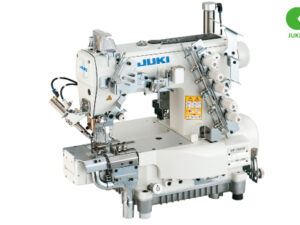
Hem finishing on knitwear, sportswear, and activewear is the primary application of this machine. JUKI interlock machines cover flatbed and cylinder-bed top and bottom coverstitch configurations.
Models available at Balaji:
- JUKI MF-7523-E11 – High-speed flat-bed top and bottom coverstitch. High-volume knitwear factories use this model for bottom hem finishing on t-shirts and jerseys.
- JUKI MF-7913D-E11-UT — This is suitable for tubular hemming where flat-bed access is not possible. High-speed cylinder-bed top and bottom coverstitch.
- JUKI MF-7923-U11 — High-speed cylinder-bed top and bottom coverstitch. Covers cuffs and collar bands in addition to standard hem applications on knit garments.
- JUKI MF-7923D-H23/UT – Semi-dry head cylinder-bed coverstitch. Light fabric lines specify this model where oil contamination on the finished seam would trigger a rejection.
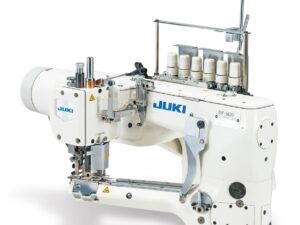
- JUKI MF-3620-L201 — 4-needle feed-off-the-arm flatseamer, top and bottom coverstitch. Sportswear and performance knitwear factories use this model for seam-joining where the seam must lie flat and not restrict movement.
JUKI Heavy Duty Sewing Machine Series
Production environments working with leather, canvas, saddlery, automotive interiors, workwear, and footwear uppers specify JUKI heavy duty sewing machines. Standard lockstitch machines cannot maintain consistent stitch integrity at the material thickness these applications require.
Models available at Balaji:
- JUKI 1510N – 1-needle unison-feed lockstitch with vertical-axis large hook. Leather goods and heavy canvas lines use this model where consistent multi-layer feeding is critical to seam quality.
- JUKI DSC-246 – Cylinder-bed, 1-needle unison-feed lockstitch. Built for curved seams on footwear uppers, bags, and saddle components where a flat-bed machine cannot reach the seaming point.
- JUKI LS-1341 – It is equipped with cylinder-bed 1-needle unison-feed lockstitch with vertical-axis hook. For tubular components in leather footwear and bag manufacturing where flat-bed access is not possible.
- JUKI LU-2810 — Semi-dry unison-feed lockstitch with vertical-axis large hook. Factories running both heavy and light materials specify this model where oil-free operation is required across the floor.
- JUKI LZH-1290 — 1-needle lockstitch zigzag with large hook. For reinforcement stitching on straps, webbing, and canvas products where lateral stitch strength is a functional requirement.
JUKI Special Machine Series
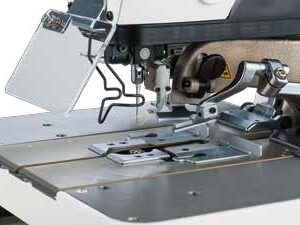
These special machines cover computerised automated functions: buttonholing, bartacking, button sewing, welting, and zigzag. On a high-volume production line, these JUKI special machines standardise output and reduce per-unit labour cost. Skilled manual intervention is removed from repeatable operations, cutting rework and increasing throughput.
Models available at Balaji:
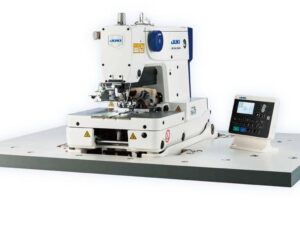
- JUKI LBH-1790AN — Computer-controlled high-speed buttonhole machine. Shirting and formal garment lines specify this model where consistent buttonhole sizing is a buyer quality requirement.
- JUKI LK-1903BN — This is a computer-controlled high-speed lockstitch button sewing machine. For automated button attachment on formal shirts and trousers at production speed.
- JUKI LK-1900BN — This machines features computer-controlled high-speed bartacking machine. For belt loop, pocket mouth, and fly reinforcement stitching where manual bartacking creates inconsistent seam strength.
- JUKI LZ-2290CF-7 — Semi-dry head digital zigzag stitch system. For bar tacking, belt loop attachment, and decorative reinforcement stitching on denim and workwear.
- JUKI APW-895N — Lockstitch automatic welting machine. For welt pocket construction on formal trousers and jackets where pocket mouth consistency affects garment grade.
Industries and Applications Where Balaji Supplies JUKI Sewing Machines
Apparel Manufacturing
Garment factories across Gujarat and Maharashtra specify JUKI sewing machines for high-volume production lines. JUKI’s computerised models hold stitch parameters steady across multi-shift operations, reducing rework and rejection rates on running lines. Balaji supplies and supports JUKI machines across apparel manufacturing clusters in Gujarat and Maharashtra.
Leather and Upholstery
Footwear uppers, bags, furniture upholstery, and automotive seat covers require consistent needle penetration and thread control through multi-layer material. JUKI’s heavy duty series handles these constructions at speed.
Commercial Textile Manufacturing
Uniform manufacturers, institutional linen producers, and workwear factories rely on JUKI sewing machines for stitch reliability on medium-to-heavy woven fabrics. Balaji, as a trusted Sewing Machine supplier, offers JUKI models to this segment and provides ongoing breakdown support to keep lines running.
Automotive and Technical Textiles
Factories producing automotive interiors, outdoor gear, safety harnesses, and technical textile products use JUKI’s heavy duty and special machines where seam strength is a functional requirement. Machine selection in this segment is driven by performance specification.
JUKI Sewing Machine Price in India
JUKI sewing machine price in India varies by model series, specification, and whether Balaji supplies the machine standalone or as a complete JUKI sewing machine with table setup. We do not maintain a published fixed-price list because the right configuration for each factory depends on production volume, fabric type, and floor layout. Those variables affect the final price.
Garment manufacturers can contact Balaji’s team directly for JUKI sewing machine price in Mumbai or for regional supply. We provide the JUKI sewing machine price list for each series on enquiry, along with a model recommendation. F
or factories assessing total cost of ownership, Balaji also advises on JUKI sewing machine with table price including installation. Factories evaluating multiple models can request the full price list of JUKI sewing machine with a single enquiry. Enquire now for JUKI sewing machine pricing and model recommendations.
Why Choose Balaji as Your Authorised JUKI Dealer in India?
Balaji Sewing Machine Pvt. Ltd. has supplied and supported JUKI sewing machines across Gujarat and Maharashtra for decades. Here are the reasons why garment manufacturers choose us-
Genuine Spare Parts
Balaji stocks genuine JUKI spare parts for every machine we supply. When a production line stops waiting for a part, every hour is a loss against the schedule. Factories that source parts through unauthorised channels risk components that accelerate wear and void manufacturer coverage.
Expert Delivery and Installation
Every JUKI sewing machine that we supply supplies is brand new. Our technical team handles delivery and installation. A trained technician sets the machine up for the fabric type and production requirement from day one, not after a week of operator adjustment.
24×7 Breakdown Support
Machine breakdowns do not follow business hours. Balaji provides 24×7 breakdown support for factories running JUKI machines supplied through us. Suppliers who take days to respond to a breakdown leave a machine idle and a production schedule behind.
60+ Years of Expertise
With 60+ years of expertise in industrial sewing machinery, Balaji advises factories and garment manufacturers on machine selection before a purchase is made. Balaji’s team assesses the production requirement first, then recommends the model.
Find the Right JUKI Sewing Machine for Your Production Needs
Apparel and textile industries trust us for guided JUKI sewing machine selection, delivery, and ongoing production support. Balaji’s team assesses fabric type, production volume, and line configuration before recommending the right model from the JUKI range. Genuine spare parts, 24×7 breakdown support, and installation by trained technicians come with every machine Balaji supplies. Contact Us Today to discuss your JUKI sewing machine requirement.
FAQs
Q: What JUKI sewing machine models does Balaji supply?
A: Balaji supplies the full JUKI industrial range: lockstitch, overlock, interlock, heavy duty, and special machines. Key models include the DDL-9000-CS, DDL-900C, MO-6704DA, MF-7523-E11, LU-2810, and LBH-1790AN, among others. Contact our Surat, Ahmedabad, or Mumbai offices for availability and delivery timelines.
Q: What is the JUKI heavy-duty industrial sewing machine?
A: JUKI heavy duty sewing machines handle thick and multi-layer materials (leather, denim, canvas, and webbing) where standard lockstitch machines cannot maintain consistent stitch integrity at speed. Models in this series include the JUKI 1510N, DSC-246, LS-1341, LU-2810, and LZH-1290. Contact Balaji for model recommendations based on your material and production requirement.